NUTRITION X ULTRA | Structuring a Fuelling Strategy for Ultras
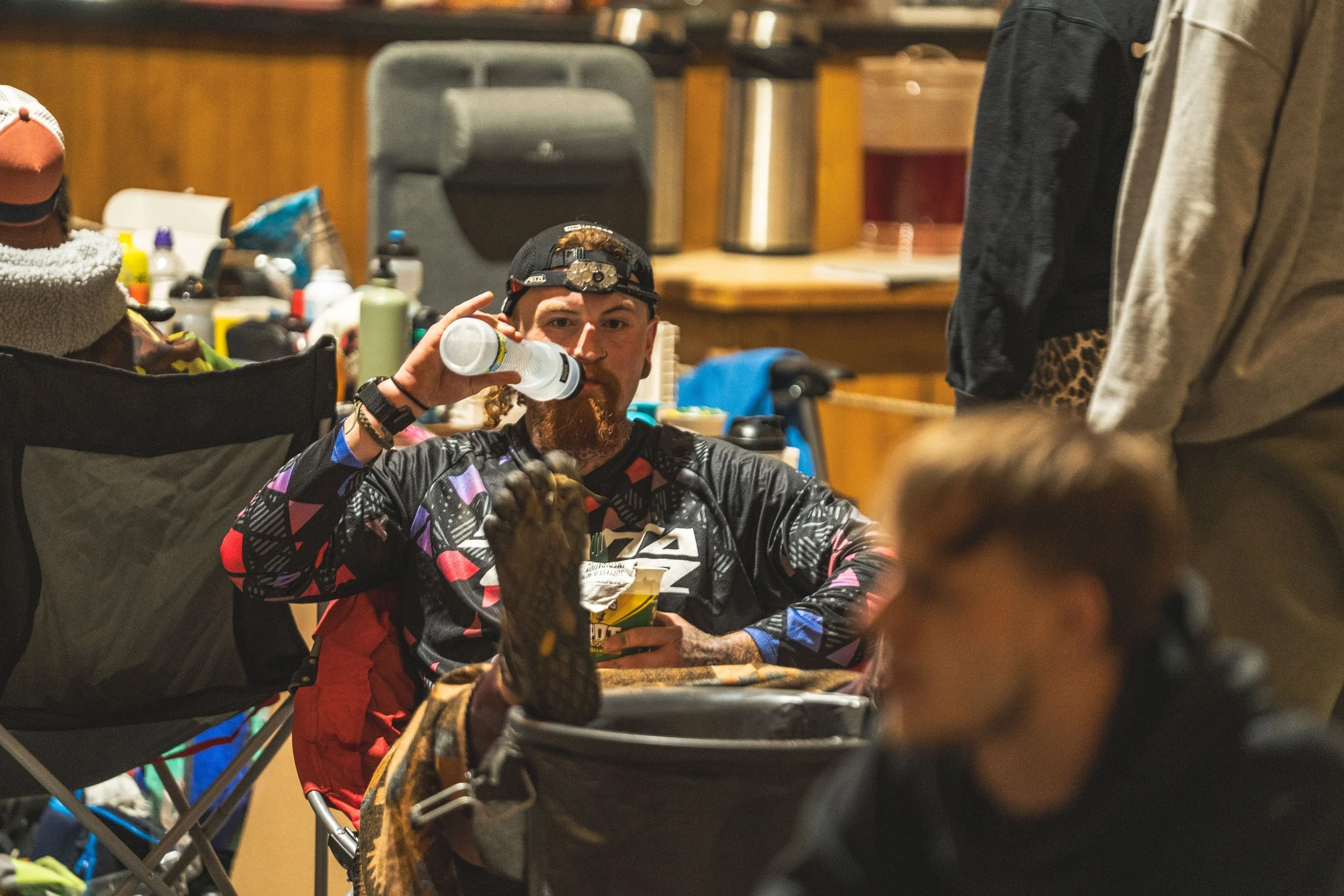
@jukedronevisuals
Let’s get one thing straight.
Ultra running is basically a glorified eating contest.
Yes, there’s the running. There’s the hills, the trails, the weather, the questionable kit choices and the inevitable point somewhere in the race where you start questioning every life decision that’s brought you to this particular patch of countryside.
But underneath all of that, you’ve got to keep eating.
For hours. And hours. Into days, sometimes…
Which is where things can get interesting.
Because fuelling an ultra isn’t simply a case of taking whatever gels you can find, necking a load of sugary shite and hoping for the best.
The longer you run, the more important it becomes to have a strategy that you can actually execute.
And that’s the key word here.
Strategy.
You need enough carbohydrate coming in to keep the engine ticking over, but you also need to consider what your stomach can tolerate, what you actually fancy eating after six hours, what is available at aid stations and, ultimately, what you can stomach when your body is telling you that everything seems about as enticing as a period drama on a sunny afternoon.
I’ve been there.
That point where another haribo looks like the most disgusting thing you’ve ever seen.
So, rather than relying entirely on one form of carbohydrate, I like to build a baseline and then layer different foods on top of it.
Which brings us nicely to…

Establish a Baseline
Before we start talking about bananas, crisps and Pot Noodles — and yes, we’ll get to the Pot Noodle — we need to establish a baseline.
For me, that baseline comes from Highland Fuel.
I’ve been using 2 scoops of Highland Fuel (BareFuel), or 1 pouch, per hour, which gives me a baseline of around 55g of carbohydrate per hour.
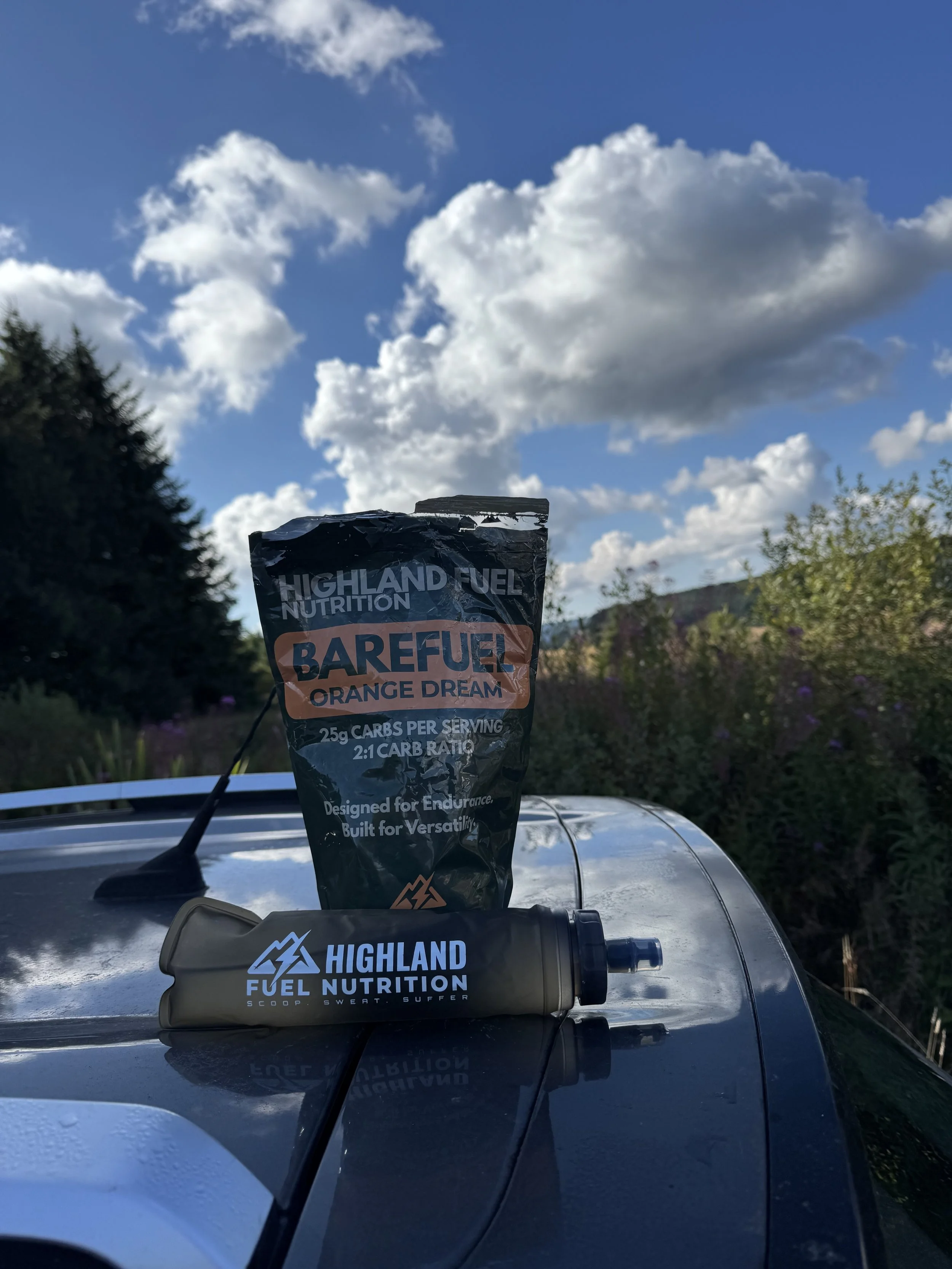
That’s the starting point.
Not necessarily the entire strategy.
The beauty of having this baseline is that you’ve already got a consistent amount of the good shit coming in each hour without having to constantly think about it.
It’s easy on the stomach, quickly absorbed and, importantly, it’s a class platform to build your strategy on.
Because from there, you can start adding in actual food.
And this is where fuelling gets much more interesting.
Rather than trying to force 80, 90 or 100g of carbohydrate down your neck exclusively through gels and drinks, you’ve got the flexibility to supplement that baseline with solids that give you different textures, flavours and carb sources.
Some sweet. Some salty. Some crunchy.
Some that resemble something vaguely approaching actual food.
And when you’ve been running for eight hours, that matters. A lot…
Build with Solids
The mistake I see quite often is treating food as an optional extra.
Something you might have if you’re feeling particularly hungry.
Solids are non-negotiable as long as they are settling well within. Whether it’s an aid station or your camp in a backyard, it’s important to load up on scran to keep the body nourished amidst what is likely to be a pretty sizeable deficit.
Once you’ve got your baseline carbohydrate coming in, you can start to layer food around it. And there’s no requirement for this to be complicated.
In fact, some of the best ultra food is about as sophisticated as what you’d find in the average petrol station.
Pickles, for example. The GOAT of running snacks in my humble opinion.
Salt, sharp and refreshing when your mouth has spent the last several hours being violently assaulted by sweet treats. They’re not there to magically solve every electrolyte problem you’ve ever had, but they can be a great change of flavour and texture.
Fruit is another go to - everything from bananas and dates when the stomach is playing ball; to citrus-based things when sickness/GI issues start to kick in.
As the hours go on, I like to vary where my energy is coming from - not limiting myself to just carb-heavy bits. Nuts are the best example - small, energy dense and probably one of the best size-to-calorie trail snacks you can pack.
That’s what building a broader strategy is all about.
Being blessed with a somewhat fragile tummy, I tend to rely largely on natural, whole foods as they are usually easier on the stomach. But that doesn’t mean there’s room for a bit of crap in the mix.
Pot Noodles, crisps, pastries and rice pudding have all featured in successful races over the years; and after six, eight, ten or twelve hours, you’re not necessarily looking for the optimal fructose:glucose ratio for carbohydrate delivery.
You might just want a crisp. And that’s okay.
The more options you have, the easier it can be to keep consuming food when your appetite starts to disappear.
The bigger point here is that none of these foods has to do everything.
That’s not the objective. The objective is to build a fuelling system where each component has a job; with Highland Fuel giving me the consistent carb baseline.
Then I can add solids around that depending on the race, conditions, duration and, most importantly, what my stomach and brain are actually willing to accept.
Crunching the Numbers
Now let’s talk numbers.
Because whilst I don’t think ultra fuelling needs to become an exercise in spreadsheet masturbation, you do need to have some idea of what you’re putting in.
If my baseline is 55g of carbohydrate per hour from Highland Fuel, I’ve already got a consistent starting point.
From there, I can add carbohydrate from food - where, having trained my gut rigorously over the years, I’ll be aiming to get an additional 35-55g carbs per hour.
For example, I might have some dates.
A few crisps.
Half a banana.
Some pretzels.
Whatever is available and whatever I’m fancying - and that’ll usually bump things up to where it needs to be.
The exact combination isn’t necessarily fixed.
And that’s deliberate.
Because ultras are unpredictable.
Your pace changes. Terrain changes. Weather changes.
Your appetite changes; and with that, your stomach changes too.
You might absolutely smash food for the first six hours and then suddenly hit a point where the mere thought of another banana makes you want to launch yourself into a hedge.
That’s why I prefer the concept of a baseline + build strategy.

You have something consistent that you’re aiming to get in each hour.
Then you’ve got a selection of solids that you can use to increase your carbohydrate intake and keep things palatable.
The important bit is to practise this in training.
Don’t turn up to a 50-miler having decided that you’re suddenly going to consume 90g of carbohydrate per hour when you’ve never trained your gut to handle it.
That’s asking for trouble.
Build gradually.
Test different foods.
Test different combinations.
Test them when you’re tired.
Test them on long runs.
Test them when it’s hot.
Test them when it’s cold.
And, ideally, test them when you’re already a bit fucked.
Because that’s when you’re going to find out what actually works.
There is a BIG difference between what you can theoretically consume and what you can realistically consume whilst running for 12, 24 or 48 hours.
They’re not always the same thing.
And I’d much rather have a strategy that you can consistently execute than one that looks fucking fantastic on paper but falls apart at hour seven.
The Final Word
Ultra fuelling doesn’t need to be complicated.
But it does need to be planned.
Start with a baseline.
For me, that’s 2 scoops of BareFuel, or 1 pouch, per hour — around 55g of carbohydrate.
It’s easy on the stomach, quickly absorbed and gives me a solid platform to build from.
Then bring in the solids.
Pickles.
Pot Noodle.
Pretzels.
Whatever works.
The key is variety.
Because when you’re eight hours into an ultra and you’ve consumed enough sweet shit to open your own confectionery department, having something salty and crunchy can suddenly feel like the greatest nutritional breakthrough in human history.
And that’s really what this is about.
Not finding the one perfect food.
Not obsessing over whether one particular gel is marginally better than another.
Not trying to create the world’s most complicated fuelling spreadsheet.
It’s about creating a strategy that gives you enough carbohydrate, is kind to your stomach, gives you options and — crucially — keeps you eating.
Because ultimately, the best fuelling strategy is the one you can actually stick to when the wheels start to come off.
And in an ultra…
They probably will.
That’s part of the fun.